The SEO Family Tree – How Every Branch of Search Now Answers to AEO

Search used to be one lane. You picked your keywords, you optimized your pages, and you waited for Google to send you traffic. That world is gone. Today search is a whole neighborhood – there are different types of SEO pulling in different directions, and sitting right in the middle of all of them is Answer Engine Optimization, or AEO. If you still think SEO is a single job, you are leaving a lot of visibility on the table. Let’s walk through the main branches of SEO, how they actually work in 2026, and where AEO quietly shows up in every single one.
The Short Answer – What SEO and AEO Mean Together
SEO is the practice of helping search engines understand and rank your content so real people can find it. AEO is the newer cousin – it is the practice of structuring that same content so AI-powered answer engines like Google’s AI Overviews, ChatGPT Search, Perplexity, and Bing Copilot can quote you directly in their responses. Think of SEO as earning the click and AEO as earning the mention. You need both, because the click only happens if the mention happened first.
On-Page SEO – The Work You Can See
On-page SEO covers everything you can directly edit on a page – titles, headings, meta descriptions, body copy, internal links, image alt text, and URL structure. It is the foundation everyone starts with because it is the part you actually control.
Where AEO slides in – answer engines read the same page you wrote for humans, but they lean heavily on clean structure. A descriptive H2 that looks like a real question, a tight one or two sentence answer right below it, and a clear follow-up paragraph is the exact pattern that gets pulled into AI Overviews. The old rule was write for people first and search engines second. The new rule is write for people first, structure for answer engines a close second, and keyword match somewhere after that.
“Your FAQs can be a goldmine for search browsers and your brand visibility.”
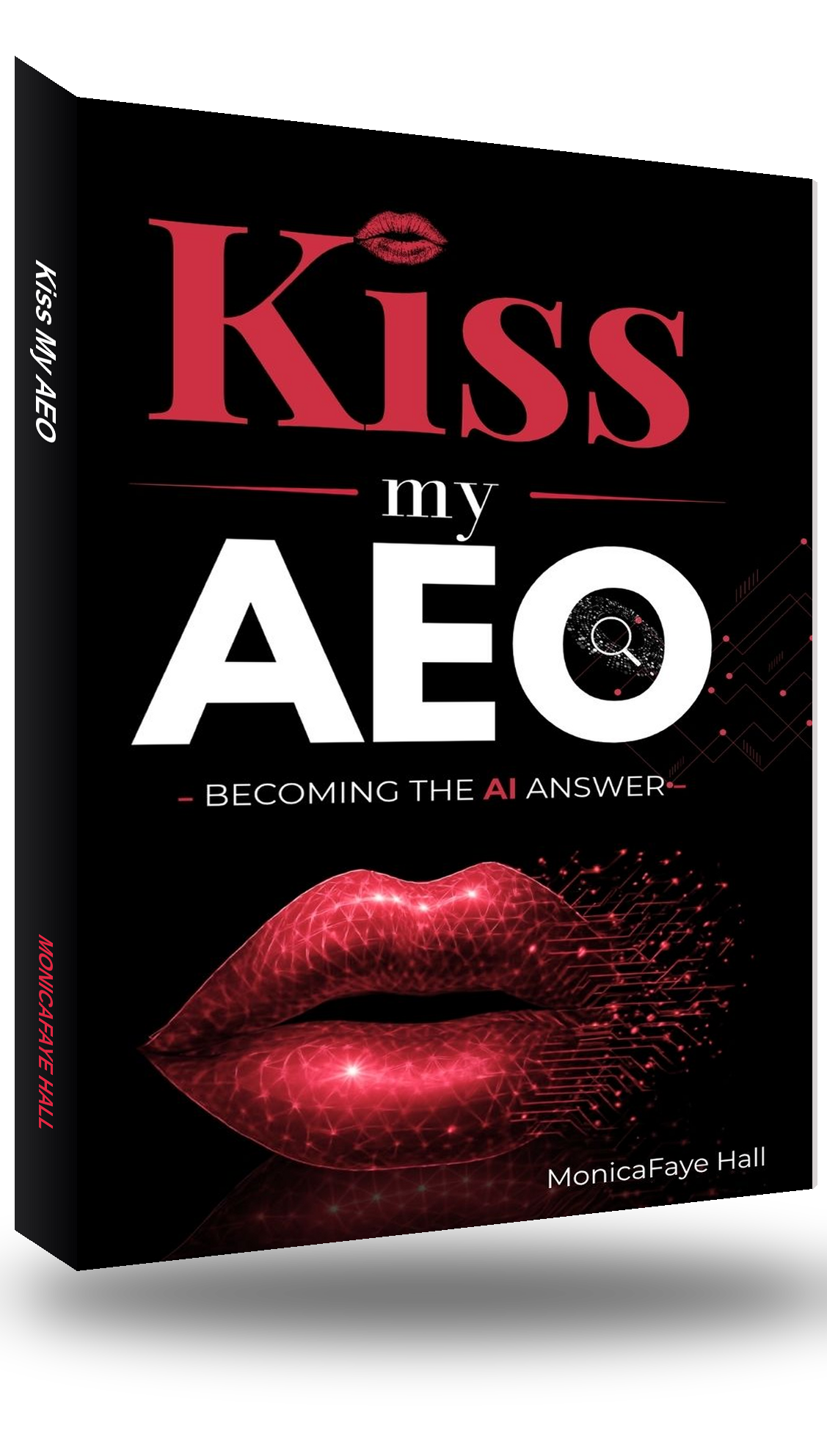
MonicaFaye Hall, Kiss My SEO
Technical SEO – The Plumbing Nobody Brags About
Technical SEO is the unsexy work that makes everything else possible – crawlability, indexability, site speed, Core Web Vitals, canonical tags, XML sitemaps, mobile rendering, HTTPS, and a clean robots.txt. If bots cannot crawl it, nothing else matters.
Where AEO slides in – schema markup. This is where technical SEO and AEO fuse into the same job. FAQ schema, HowTo schema, Article schema, Product schema, and Organization schema are the signals that tell answer engines what your content actually is. A page without structured data is basically whispering in a crowded room. Add schema and suddenly the bots can hear you, quote you, and credit you.
“Consider the AI-delivered results as a guide to develop the foundation of the topic or copy you are developing.”
MonicaFaye Hall, Kiss My SEO
Off-Page SEO – The Reputation You Build Elsewhere
Off-page SEO is everything that happens outside your own website that still shapes how search engines see you. Backlinks from trusted domains, brand mentions on industry sites, digital PR, guest posts, podcast appearances, and citations in directories all pile up into what used to be called domain authority.
Where AEO slides in – answer engines do not just crawl your site, they cross-check you against the rest of the web. If your name, brand, and expertise show up consistently on reputable third-party sources, large language models treat you as a trustworthy entity and are far more likely to surface you in an answer. Unlinked brand mentions used to be wasted. In an AEO world they are gold, because LLMs learn from text, not just from hyperlinks.
Local SEO – Winning the Map and the Neighborhood
Local SEO is how brick-and-mortar businesses and service-area companies show up for searches with local intent – near me queries, city-based keywords, and the map pack. The core moves are an optimized Google Business Profile, consistent NAP data across directories, a steady flow of genuine reviews, and locally relevant content.
Where AEO slides in – when someone asks an AI assistant for the best coffee shop in Charlotte or a good CPA close by, the answer engine is pulling from your Google Business Profile, your reviews, and your website’s local schema all at once. Clean LocalBusiness schema, direct answers to neighborhood-specific questions on your site, and review responses written like a real human being are what get you pulled into a voice answer or a chatbot recommendation.
“Voice search most often showcases location-based search queries.”
MonicaFaye Hall, Kiss My SEO
Ecommerce SEO – Product Pages That Actually Convert
Ecommerce SEO is its own beast because the stakes are different. You are optimizing category pages, product detail pages, filters, and an endless tangle of variants. Canonical handling, crawl budget, unique product descriptions, and solid internal linking separate the stores that rank from the stores that disappear on page four.
Where AEO slides in – shopping is getting answered, not just searched. Shoppers now ask AI assistants which moisturizer is best for oily skin under fifty dollars, and the assistant responds with a short-list pulled from Product schema, reviews, and editorial content. If your product pages have detailed specs, honest comparisons, real review content, and proper Product and Review schema, you have a real shot at being in that short-list. If they do not, you are invisible no matter how good the product is.
Content SEO – The Strategy That Holds It All Together
Content SEO is the editorial brain of your whole program – keyword research, topic clusters, pillar pages, search intent mapping, and internal linking that makes your site feel like a library instead of a pile of posts. It is how you prove topical authority instead of just chasing one-off keywords.
Where AEO slides in – answer engines reward depth, and they reward it at the topic level, not the page level. If you write one article about the different types of SEO but never cover any of them in detail, an LLM has nothing to quote from you. If you have a pillar page and ten supporting articles that each go deep on one branch, the answer engine starts to treat your domain as the authority on that topic and pulls from you over and over. Topic clusters were always smart SEO. In 2026 they are the single biggest lever for AEO.
International SEO – Showing Up in Every Language That Matters
International SEO handles the complexity of serving multiple countries or languages – hreflang tags, localized content, country-specific domains or subfolders, and cultural nuance that a translation plugin cannot fake. Done well, it opens entire markets. Done poorly, it creates duplicate content that cannibalizes itself.
Where AEO slides in – answer engines are multilingual by default, and they are getting very good at matching the language of the question to the language of the source. If your Spanish page is a lazy machine translation with no local context, an LLM will skip you and quote a competitor who actually wrote for that audience. Native-sounding copy plus proper hreflang plus localized schema is what earns a spot in non-English answer results.
Video and Visual SEO – The Channels Humans Actually Prefer
Video SEO covers YouTube optimization, video schema, transcripts, chapters, and thumbnails. Visual SEO covers image compression, descriptive alt text, image sitemaps, and Pinterest-style discovery. Both matter more than ever because a huge slice of search now starts on a video platform or an image feed.
Where AEO slides in – AI Overviews frequently embed a short YouTube clip or pull a quote straight from a transcript. If your videos have clean captions, timestamped chapters, and a written summary on the page they live on, you become fair game for that placement. Alt text stops being a checkbox and starts being a real ranking signal because multimodal models read your images the same way they read your paragraphs.
Bringing It All Home – The Integrated SEO and AEO Playbook
Here is the honest truth. The different types of SEO are not separate strategies anymore, and AEO is not a bolt-on you do after the fact. They are one conversation. Your on-page copy feeds the answer engines. Your technical foundation lets them read you. Your off-page reputation tells them whether to trust you. Your content strategy proves you own the topic. And your local, ecommerce, international, and video work all decide which questions you get to answer.
If I had to hand you one takeaway, it would be this – write like a real person, structure like a careful editor, and mark up like an engineer. Do those three things at the same time and you will show up in classic blue links, featured snippets, AI Overviews, and chatbot answers without having to pick a lane.
Frequently Asked Questions
Is AEO replacing SEO?
No. AEO is an extension of SEO, not a replacement. Answer engines still rely on the same crawling, indexing, and ranking signals that classic SEO produces – they just add a layer on top that rewards clarity, structure, and demonstrated expertise.
What is the fastest AEO win for a site that already has decent SEO?
Rewrite your top ten pages so each main section opens with a real question as an H2 and a two to three sentence direct answer right beneath it. Then add FAQ schema. That one pass often doubles the number of AI Overview appearances within a few weeks.
Do backlinks still matter for AEO?
Yes, and brand mentions matter almost as much. Answer engines use the broader web to decide who is trustworthy on a topic, so being referenced, quoted, or linked from reputable sites is still one of the strongest signals you can build.
How do I know if AEO is actually working?
Watch for impressions in Google Search Console on AI-driven result types, track referral traffic from ChatGPT, Perplexity, and Copilot in your analytics, and search your own brand inside each answer engine to see whether you get cited. If your name starts showing up in answers where it did not before, the work is landing.